TAR/TAA for Ankle DJD and Deformities
Development of Ankle Arthroplasty
The deterioration of the upper ankle (DJD, degenerative joint disease) is usually a late result of a serious joint injury. In addition to accidents, ankle deterioration is also within the framework of primary osteoarthritis, rheumatoid joint destruction and other systemic diseases or infections. In the past the treatment required a fusion procedure (arthrodesis of the ankle joint) followed by a lengthy healing period and the implementation of orthopedic footwear.
Since 1970 it has been attempted to obtain mobility with an endoprosthetic joint replacement. The initial cemented prostheses were mechanically inadequate and led to premature loosening. Since the mid-eighties the modern uncemented and three-component-model were developed. It was successful as it has a good long-term result and not much bone was removed during the implantation. Since 1999, we have been able to perform successful ankle-endoprosthesis implantation.
Through the further development of the prosthesis there have been improvements in the anchoring in the bone. The more anatomical shape of the components led to better motion possibilities and reduced wear of the poly. Now we have a vast number of prosthetic sizes and diversities, which allows a better implant choice for different patients. A good result can be achieved when it is inserted in selective patients.
Development of the Ankle-Implantation-Technique
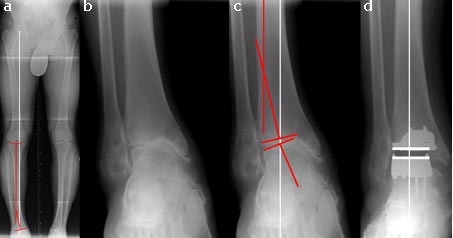
Till now minority of the patients have received prostheses. The reason for this is that a restrictive indication for joint replacement occurred. This was a result of the high frequency (80% of the cases) of accompanying deformities in osteoarthritis patients. This was a contraindication to the TAR/TAA; therefore Dr Boack developed the new surgical technique for the one-stage correction of severe deformities and the implantation of the prostheses.
The new technique could treat misalignments up to 40°. This resulted in new possibilities for many patients and the narrow range of indications could be considerably extended. This allows an additional 3-4 patients being successfully treated per a week. Despite the extensive corrective surgery, patients who had minimal invasive surgery could start earlier with physiotherapy and mobilization. Due to rapid pain relief and possibility of immediate treatment after the surgery patients could achieve an increased joint motion. This treatment option has also contributed significantly to the good functional results after correction of the deformity.
Bone defects or malformations could be replaced with a custom made prosthesis, which is specially made for the patient with the assistance of a computer analysis.